| Top 10 Autocratizing Countries, 2010 - 2024 | |||||
| Country | Change | LDI Start1 | LDI End1 | Regime Start | Regime End |
|---|---|---|---|---|---|
| Hungary | −0.36 | 0.68 | 0.32 | Electoral Democracy | Electoral Autocracy |
| El Salvador | −0.33 | 0.43 | 0.09 | Electoral Democracy | Electoral Autocracy |
| Serbia | −0.29 | 0.51 | 0.22 | Liberal Democracy | Electoral Autocracy |
| Mauritius | −0.29 | 0.66 | 0.37 | Liberal Democracy | Electoral Autocracy |
| Mali | −0.26 | 0.41 | 0.15 | Electoral Democracy | Closed Autocracy |
| Türkiye | −0.26 | 0.37 | 0.12 | Electoral Democracy | Electoral Autocracy |
| India | −0.25 | 0.54 | 0.29 | Electoral Democracy | Electoral Autocracy |
| Greece | −0.24 | 0.81 | 0.58 | Liberal Democracy | Electoral Democracy |
| Burkina Faso | −0.22 | 0.35 | 0.13 | Electoral Democracy | Closed Autocracy |
| Mexico | −0.22 | 0.47 | 0.25 | Electoral Democracy | Electoral Democracy |
| Source: V-Dem Institute, Varieties of Democracy Dataset | |||||
| Note: Regime types are based on passing separate thresholds for elections and liberal rights (not the LDI score). | |||||
| 1 LDI = Liberal Democracy Index | |||||
Lecture 3.1
Democratic Backsliding
Emmanuel Teitelbaum
What is Backsliding
Regime Types
- Democracies
- Free and fair elections
- Protection of civil liberties
- Hybrid regimes (illiberal, semi-authoritarian)
- Elections, degree of fairness in question
- More restricted civil liberties
- Authoritarian regimes
- No elections, or rigged elections
- No basic rights and liberties
Democratic (or Authoritarian) Backsliding
“[A] decline in the quality of democracy, when it occurs within democratic regimes, or in democratic qualities of governance in autocracies.”
Lust and Waldman
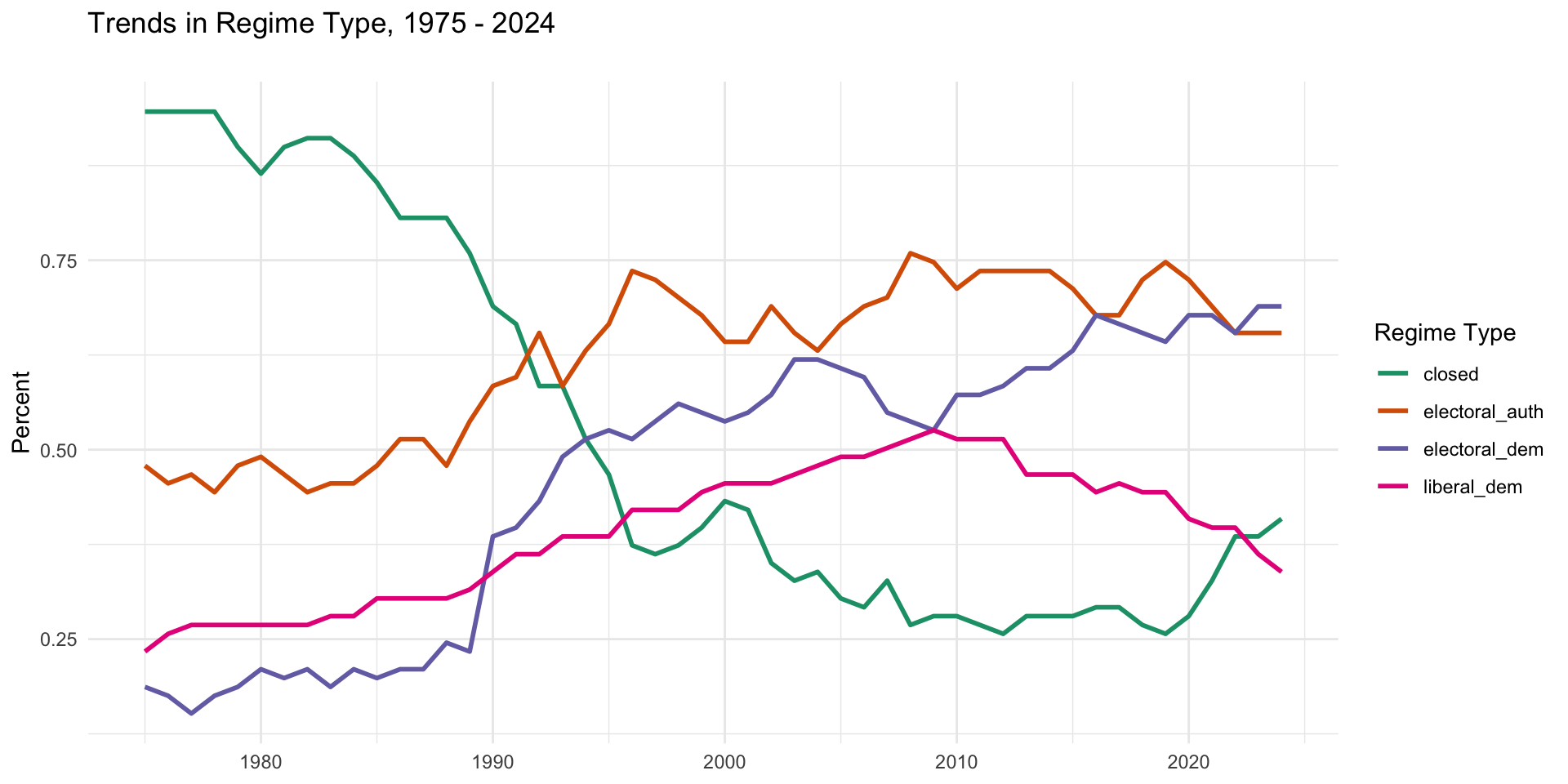
Regime Type Trends
The Biggest Backsliders
Common Mechanisms of Backsliding
- Constitutional amendments to enhance executive authority
- Elimination of checks and balances, reduction of accountability
- Centralization of executive power through purges
- Intimidation of media and civil society
- Elimination of political competition
- attacks on competitors
- rigged elections
Methods of Backsliding (Bormeo)
- Old Way
- Open-ended coups
- Executive coups
- Vote fraud
- New Way
- Promissory coups
- Executive aggrandizement
- Strategic harassment and manipulation
Discussion
U.S. in Comparative Perspective
- Kaufman and Haggard reading
- How has backsliding occurred in middle-income countries?
- How similar is the U.S. to these countries?
- What kind of regime is the U.S.?
Theories of Backsliding
Hypotheses (1/3)
- Leadership
- State strength and autonomy (how leaders create it)
- Role of elites in negotiating transitions, dividing power
- Culture
- Civic culture
- Social capital and education
Hypotheses (2/3)
- Specific types of political institutions
- Presidential vs. parliamentary systems
- Consociationalism (for divided societies)
- Electoral institutions
- PR vs SMD
- If PR type of lists
- Party fragmentation and instability (e.g. Indonesia)
- International factors
- International orgs (foreign aid, election monitoring, etc.)
- Alliances (who are your friends?)
Hypotheses (3/3)
- Social structures
- Class (bourgeoisie, working class, etc.)
- Ethnic fragmentation
- Relevance of economic and political exclusion
- Economic factors (see below)
Political Economy of Backsliding
Wealth
- Exogenous Democratization
- Rising wealth makes backsliding less likely
- “No democracy was ever subverted in a country with a per capita income higher than Argentina in 1975: $6,055” (Przeworski)
Inequality
- “Redistributivist” theory
- Democracy is more durable in egalitarian societies
- When the poor demand redistribution of elite’s wealth, elites react by “digging in their heels” because redistribution would be too drastic (Acemoglu and Robinson 2006)
- Demands for redistribution are less in societies with lower inequality and societies where assets of elites are mobile (Boix
- Competition from rising elites (Ansell and Samuels 2014)
Macroeconomic Performance
- Literature especially focused on growth and inflation (Kapstein and Converse)
- High growth rates \(\rightarrow\) less risk of backsliding
- High inflation increases risk
- Arguably more about regime stability than democracy
- Applies equally well to authoritarian regimes
- High performing autocracies likely to survive
- “Performance legitimacy”, e.g. China
Natural resource wealth
- Undermines democracy
- Promotes authoritarianism
- Focus of next week’s discussion
Exercise
Group Exercise
Explore the Democracy Around the World App
Discuss
- Pick a backsliding country
- How would you explain its democratic decline